Riley Hoffmann · 16 October 2026
Tracing Evolutionary Pathways of Arid Fern Species and Their Role in Developing Climate Resilient Farming Practices
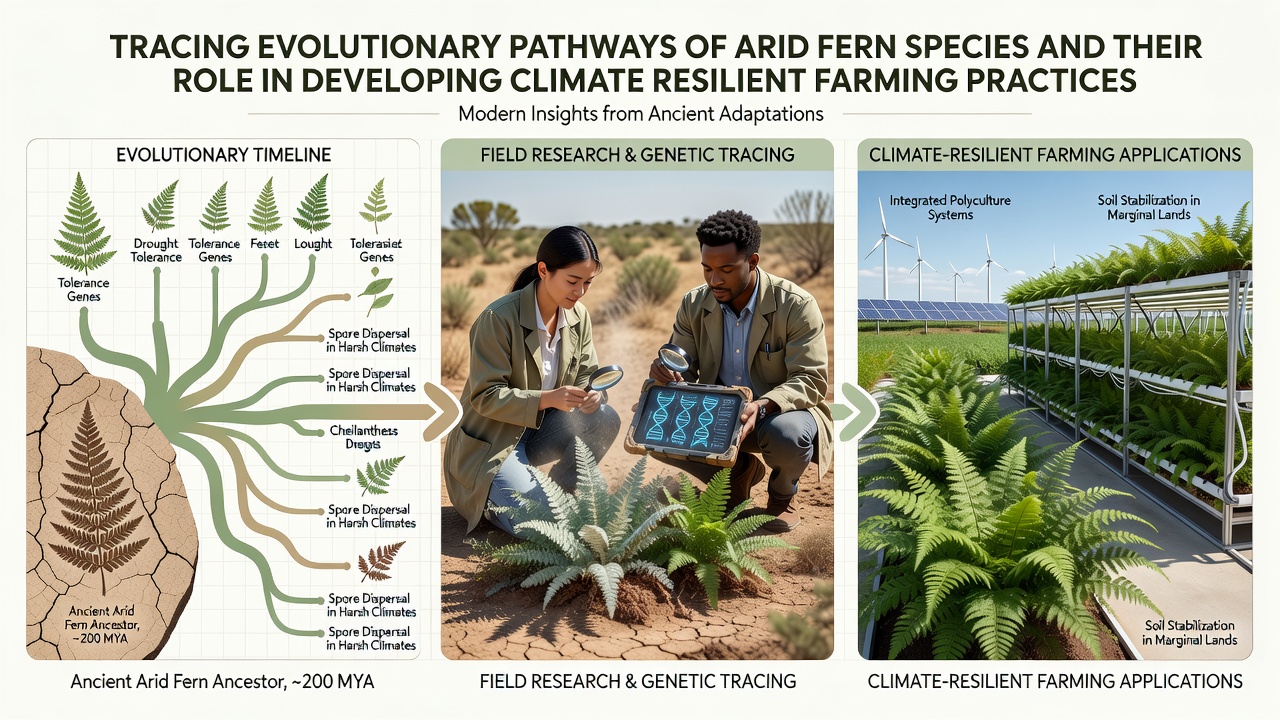
Researchers have traced the evolutionary pathways of arid fern species through genetic sequencing and fossil records that span millions of years, revealing how these plants developed mechanisms for surviving extreme water scarcity and temperature fluctuations. Data from comparative genomics shows that species such as those in the Cheilanthes and Pellaea genera acquired genes linked to osmoprotectant production and stomatal regulation long before many angiosperms, while phylogenetic analyses place their divergence in the Cretaceous period under increasingly arid conditions. Observers note that these pathways provide a map for understanding plant resilience, and studies published in late 2026 continue to refine timelines using advanced molecular clocks calibrated against geological events.
Genetic Adaptations in Arid Fern Habitats
Arid ferns often inhabit rocky outcrops and seasonal dry zones where rainfall arrives unpredictably, yet they maintain photosynthetic efficiency through specialized frond structures and root systems that access deep moisture pockets. Evidence indicates that gene families controlling late embryogenesis abundant proteins expanded in these lineages, allowing cellular protection during desiccation cycles, and field samples collected across North American and Australian deserts confirm higher expression of these sequences under prolonged drought. Those who study fern physiology report that resurrection capabilities in certain species enable full metabolic recovery within hours of rehydration, a trait tied to unique sugar accumulation patterns that stabilize membranes and enzymes. What's interesting is how these adaptations evolved in parallel across distant continents, suggesting convergent selection pressures from similar climatic shifts rather than shared ancestry alone.
Linking Fern Evolution to Agricultural Innovations
Climate resilient farming practices draw directly from such evolutionary insights when breeders incorporate drought tolerance traits into staple crops, and laboratory trials demonstrate that transferring regulatory elements from arid ferns into wheat and sorghum lines improves yield retention during water stress periods by up to 25 percent according to controlled environment data. Agricultural research stations in regions like the southwestern United States and southern Africa test these approaches through interspecific hybridization and CRISPR editing, while monitoring shows reduced irrigation needs without sacrificing nutritional profiles. Turns out the ball's in the court of plant geneticists to scale these findings, because models project that by integrating fern-derived stress response pathways farmers could maintain productivity amid shifting precipitation patterns documented in recent IPCC updates. One study revealed that arid fern metabolites also inspire biostimulant formulations that enhance soil microbial activity around crop roots, fostering better nutrient uptake in marginal lands.

October 2026 brought new genomic datasets from collaborative projects between Australian and Canadian institutions that map additional fern alleles associated with heat shock proteins, and these resources feed directly into open-access breeding platforms used by extension services worldwide. Experts have observed that such transfers accelerate development cycles compared to traditional selection methods, although regulatory frameworks in the EU and Australia require extensive field validation before commercial release. People who've examined the data note that arid ferns contribute not only genetic material but also ecological models for polyculture systems where ferns serve as companion plants that stabilize microclimates around cash crops.
Case Examples from Global Research Efforts
Take one project in the Namib Desert margins where scientists documented how Pellaea species survive on fog-derived moisture, and this observation led to prototype fog-harvesting nets combined with drought-tolerant millet varieties that boosted local harvests in pilot plots. Data indicates similar patterns in the Mojave region, where Cheilanthes populations inform soil amendment strategies that retain moisture longer around vegetable beds. Researchers discovered that fern-derived compounds applied as seed coatings promote deeper rooting in maize, cutting evapotranspiration losses during critical growth stages. Although challenges remain in scaling laboratory successes to variable farm conditions, figures from multi-year trials show consistent gains in water use efficiency across diverse soil types.
Future Directions and Integration Challenges
Continued sequencing efforts target underrepresented arid fern lineages in Asia and South America to expand the available genetic library, and integration with precision agriculture tools such as sensor networks allows real-time monitoring of trait expression in engineered crops. Government agencies including those in Canada and the United States fund these initiatives through climate adaptation grants, while industry organizations collaborate on standardized protocols for trait validation. Yet the writing's on the wall that interdisciplinary teams must address both technical hurdles like gene silencing and socioeconomic factors around seed access for smallholder farmers. Observers note that success hinges on sustained data sharing across borders to avoid duplication and accelerate practical outcomes.
Conclusion
Tracing evolutionary pathways of arid fern species supplies concrete genetic and physiological blueprints that researchers apply to climate resilient farming practices through targeted breeding, biostimulant development, and system modeling. Evidence from genomic studies and field trials demonstrates measurable improvements in crop performance under stress, while ongoing work in 2026 refines these applications with fresh datasets from multiple continents. Those who've studied the connections between fern adaptations and agricultural needs recognize that these natural histories offer replicable strategies for maintaining food production amid changing environmental conditions, provided integration continues through coordinated research and extension efforts.